Jack of All Trades.
Master of Your Body.
The phrase was always an insult. It shouldn't be. On specialisation, what it costs the body, and why the most capable humans were never the most specialised ones.
Get on the floor and crawl. Not a specific pattern — just move. Forward, sideways, change direction, find your way around an obstacle. Stay low, keep it slow, and notice what happens when your body is asked to coordinate without a script.
For most trained people, something interesting occurs within about thirty seconds. The movement that felt fluid in a familiar exercise — the hinge, the press, the run — becomes tentative the moment the pattern disappears. The body that is strong in its lane becomes uncertain off-road. Not weak. Uncertain. It has the tissue. It doesn't have the vocabulary.
That gap — between physical capacity and physical intelligence — is what this article is about.
The Insult We Accepted.
The full original phrase is worth knowing. Jack of all trades, master of none, though oftentimes better than master of one. Somewhere along the way, the second half got dropped. What remained was a warning: breadth is dilettantism. Depth is the only thing worth pursuing. Focus, specialise, optimise. Do one thing and do it completely.
This value system is so thoroughly absorbed that most people never question it. It shapes careers, identities, training programmes, and the quiet shame of anyone who has ever been interested in more than one thing at once. The specialist is serious. The generalist is scattered. The person who runs marathons and lifts and climbs and refuses to pick one — they are, implicitly, not doing any of it properly.
The body has paid for this idea. So has the person inside it.
What Over-Specialisation Does To The Body.
The body is a faithful record of what you repeatedly ask it to do. Train in one plane, one pattern, one range of motion, for long enough — and the body becomes exquisitely capable there, and increasingly unavailable everywhere else. Tissue remodels around the demand. The nervous system deepens the pathways it uses and prunes the ones it doesn't. What gets rehearsed gets reinforced. What gets ignored gets lost.
This is not a flaw in the body's design. It is exactly how adaptation is supposed to work. The problem is not the mechanism — it is the narrowness of the input. A runner's hip flexors shorten around the demands of forward propulsion. A lifter's thoracic spine stiffens around the demands of bracing under load. A desk worker's entire posterior chain lengthens into permanent protest against a position no human body was ever meant to hold for eight hours a day. Each body is doing its best with what it's been given. Each body is also, quietly, becoming less.
The signs tend to be subtle at first. A movement that used to feel natural starts requiring thought. A direction the body used to move through freely develops resistance. Strength that was genuinely impressive in one context turns out not to transfer to another. And then, eventually, something breaks down — not because the body was pushed too hard, but because it was pushed in only one direction for too long, and it ran out of capacity to compensate.
Notice This
Think about your primary training. The thing you do most, the pattern your body knows best. Now ask honestly: what is the movement it has never asked of you? Not the movement you avoid because it's hard — the movement that simply doesn't exist in your world.
That absence is not neutral. The body is not just missing a skill. It is missing the tissue, the neural pathways, the proprioceptive maps for an entire range of human movement. And over time, absence compounds. What you don't use, you don't just lose access to. You lose the capacity to regain it easily.
The Evolutionary Argument.
Here is the thing about human beings as a species: we are not the fastest animal. Not the strongest. Not the most powerful relative to our size. We cannot outrun a horse, outswim a seal, or outclimb a chimpanzee. By almost every measure of physical specialisation, we are unremarkable.
And yet we are here, and most of our predators are not.
What humans did — what distinguished us across hundreds of thousands of years of survival — was adaptability. We could run long distances at moderate pace and then climb, carry, throw, dig, swim, and build. We could traverse radically different terrain and load demands within a single day. We could persistence hunt across hours and then haul the kill home and construct shelter. The body that survived was not the most specialised body. It was the most broadly capable one.
Specialisation, in evolutionary terms, is fragile. The cheetah is the fastest land animal on earth and one of the most vulnerable big cats — its entire physical architecture is optimised for one thing, and when that one thing is disrupted, the animal has no fallback. Breadth is resilience. The generalist body can meet what it hasn't seen before. The specialist body cannot.
We have spent the last century building training cultures that celebrate the cheetah and produce bodies that are, in the deepest sense, less human than the ones they replaced.
Identity And The Cost Of The Single Lane.
There is something that happens to a person who has organised their identity around one physical domain. It is visible in the way they talk about their training — not as something they do, but as something they are . The runner. The lifter. The cyclist. The label is worn with pride, which is understandable. It took real work to earn.
But identity built on a single physical lane is fragile in the same way the cheetah is fragile. When injury comes — and it comes, to almost everyone who trains long enough in a narrow enough range — it does not just take away the training. It takes away the self. The runner who cannot run does not just lose fitness. They lose the story they have been telling about who they are. The loss is not proportional to the physical disruption. It is much larger, because the identity had no other load-bearing structure.
This is worth sitting with. Not as a criticism of commitment or dedication — both are genuinely admirable. But as a question: what is the body for, in your life? Is it a vehicle for one specific kind of performance? Or is it the actual place you live — the thing that carries you through the full range of what a human life asks?
The two answers produce very different training practices. And very different people.
The body is not a vehicle for performance. It is the place you live.
The Generalist Body.
The generalist body is not the mediocre body. This is the misunderstanding that the dropped half of the phrase has been producing for centuries. Breadth is not the absence of depth. It is depth distributed across a wider range of demands — which requires, if anything, more intelligent training, not less.
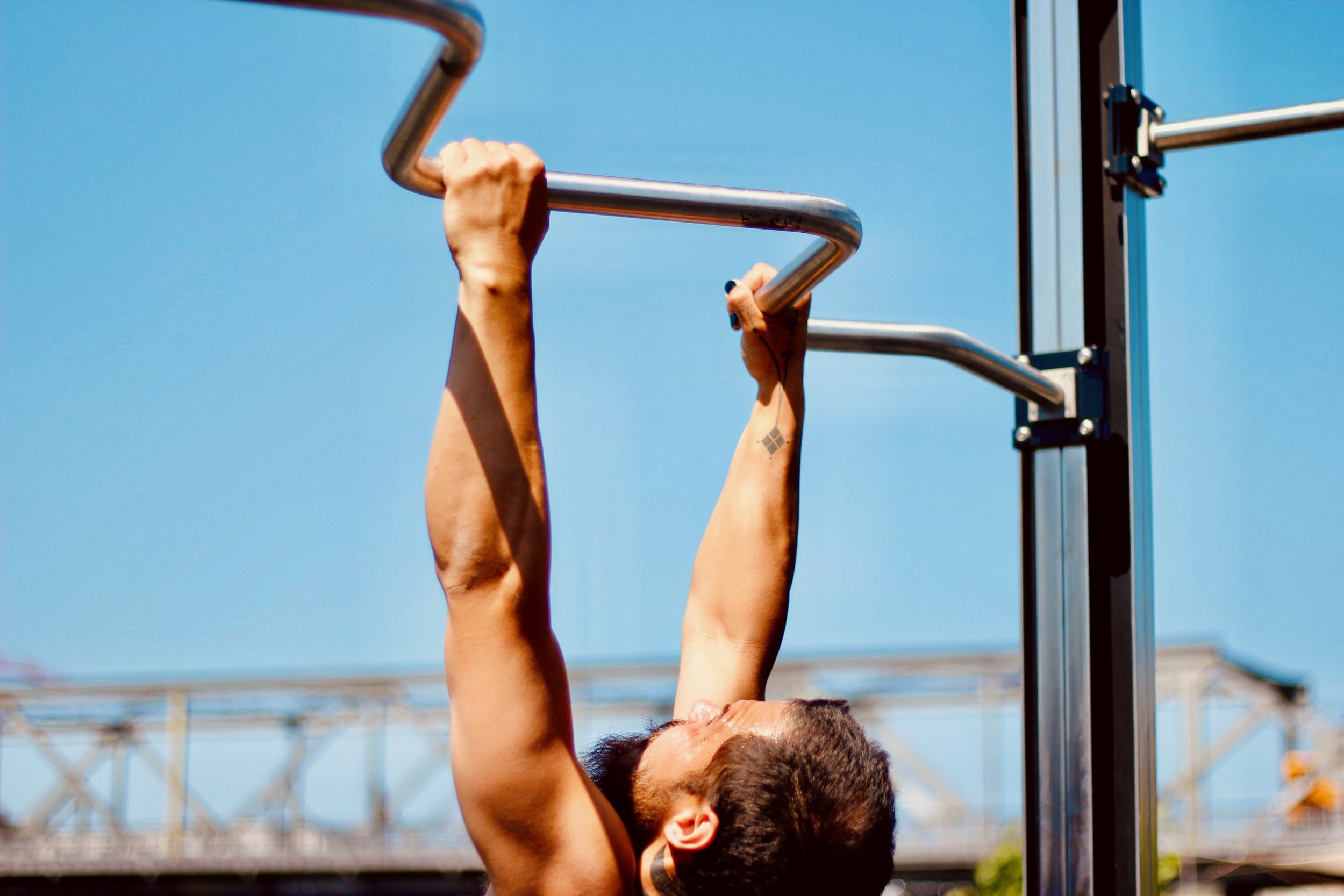
What the generalist body can do: run, not necessarily fast but far enough and reliably. Lift, not necessarily maximum loads but significant ones with good mechanics. Hang, climb, crawl, carry, balance, rotate, absorb unexpected force from unexpected directions. Get off the floor from a variety of positions. Move through a full day of physical life — a long walk, an impromptu game, a heavy bag, a tight space that requires getting low — without any of it being exceptional, and without any of it causing harm.
This is not a lower standard. It is a different one — and in many ways a harder one. The specialist can disappear into their lane and optimise endlessly within it. The generalist has to remain honest about the whole body, has to keep training the patterns that don't come naturally, has to resist the pull toward the comfortable and familiar. It requires a particular kind of discipline: not the discipline of doing one thing harder, but the discipline of doing many things well enough that none of them become a limitation.
Physical intelligence is not the accumulation of skill in a single domain. It is the nervous system's capacity to draw on a broad library of movement and apply it to whatever the situation requires. A body trained broadly does not just have more options available. It has a different relationship with uncertainty — with new demands, unfamiliar terrain, unexpected loads. It trusts itself more widely, because it has been tested more widely. And that trust is not a feeling. It is a physical fact, built into the tissue and the nervous system through years of broad, honest, varied movement.
Master Of None — And Better For It.
The original phrase was right. Not as an insult — as a description of something worth building toward.
Not the master of running. Not the master of lifting. Not the master of any one physical domain, because mastery of one domain at the cost of everything else is not mastery of the body — it is mastery of a slice of it, paid for with the rest.
The body worth building is the one that can be surprised. That can be taken somewhere it has never been and find its footing. That ages not by narrowing into the one or two things it can still do, but by remaining broadly available to what life asks — because it was trained that way from the beginning.
Jack of all trades. Master of your body. Oftentimes better than master of one.
That was always the complete thought.