What the Body
Already Knows.
On the principles behind strength training — how the body learns, which movements carry the most, and what it means to build something that lasts.
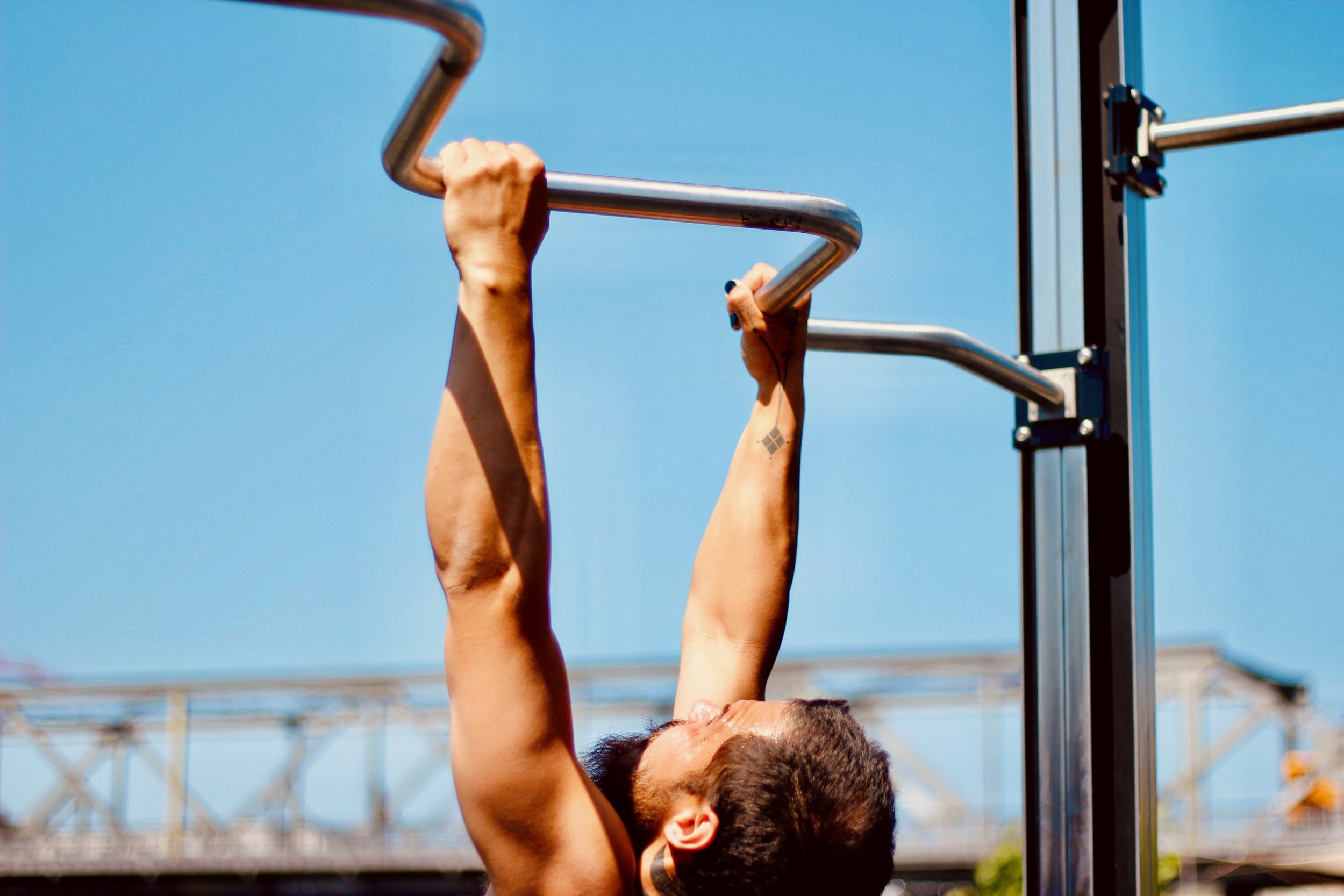
Find something to hang from and hang for thirty seconds. Not as a test — just as an introduction. Feel what your shoulders do when the weight is actually in them, whether both sides sit level, whether you're gripping to survive or settled enough to notice. If thirty seconds feels easy: without pulling up, press one blade down and try to level both shoulders. Feel what that small act of depression changes in the whole structure. That's the beginning of what this article is about.
Connection.
There is a quality that separates a body that has trained patterns from a body that has trained muscles. It doesn't show up clearly in how someone looks. It shows up in how they move — in the coherence of it, the availability of it, the way force travels through the body without leaking.
Call it connection. Your nervous system's ability to coordinate structures that have learned to work together, to produce movement that flows rather than fires in pieces. A body with this quality doesn't just perform exercises it has rehearsed. It meets whatever arrives — an unfamiliar load, an unstable surface, a sudden demand for force in a position it has never trained explicitly. It adapts in the moment because it has a vocabulary for the situation.
Most training, without intending to, builds the opposite. Muscles that are strong in isolation and disconnected in practice. A body that performs well in the gym and struggles everywhere else.
This article is about how to build the other thing.
How Your Body Actually Changes.
Your body doesn't change because you worked hard. It changes because it perceives a demand it cannot currently meet — and it adapts to meet it. Muscle tissue rebuilds slightly stronger. Tendons and ligaments remodel more slowly, over months and years rather than weeks. Your nervous system learns to recruit motor units more efficiently — which is why early strength gains come before visible muscle growth. The body is not getting bigger yet. It is getting smarter.
What the nervous system is actually learning, in a well-designed practice, is not just how to fire a muscle. It is how to coordinate a pattern. How to sequence the hip and the spine and the shoulder into something that works as a whole. How to transfer load through the body without losing it somewhere in the middle. This is the neurological foundation of connection — and it is built through consistent, intelligent exposure to movement over time.
Progression is what keeps the adaptation happening. A stimulus your body has already absorbed is not a stimulus — it is maintenance. More load, more range, more complexity, more time under tension. Not always more weight. But always forward. And patience is not a virtue here — it is a requirement. The connective tissue that gives your shoulder its resilience or your knee its integrity remodels over years. The training that matters most is not the session that destroyed you. It is the one you showed up for the following week.
"Where your fear is, therein lies your task." — C.G. Jung
There is a Jungian principle that applies here with uncomfortable precision. The movements you avoid — the ones that feel unstable, exposing, or simply unfamiliar — are rarely random. Your body does not lie about what it has been protecting. A person who never hangs, never squats deep, never loads through full range is not simply untrained. They are living inside a smaller map than their body is capable of. Training is how you redraw it. Notice which movements you approach with reluctance. That territory is exactly where the work is.
The Movements That Carry The Most.
There is no shortage of exercises. There is, however, a small number of movement patterns so fundamental that building strength within them transfers to everything else. They are generative by nature — you do not graduate from them, you go deeper into them. The sophistication is already inside.
The squat and the lunge form the complete education of your hip — one bilateral, one unilateral, together covering depth, orientation, asymmetry, and load. The hinge — deadlift, Romanian, forward fold — teaches your posterior chain to work as a unit, absorbing and producing force without leaking it through a disconnected middle. The hang decompresses, opens, and more than anything else teaches your shoulder what it is actually capable of feeling. For most people, this practice alone — consistent, progressive, attentive — would change more than years of conventional training have.
Above the waist, the pull-up is the benchmark: relative strength, real connection across the back and shoulder girdle, nothing to hide behind. The row trains the same structures horizontally, building the posterior chain of the upper body and scapular control under load. The push-up trains your body as a rigid connected system — where it breaks down tells you exactly what is missing. The dip demands full shoulder extension under load, one of the most challenging and rewarding positions the shoulder girdle can develop. Weighted pressing adds load management and volume to the same patterns. These are not separate categories. They are the same conversation in different registers.
None of these movements has a ceiling. Your squat deepens into single-leg expressions of balance and strength that take years to develop. Your hang progresses into active, loaded, precise work — the scapular awareness you felt at the start of this article is just the first layer of what is available there. Your push-up becomes a foundation for straight-arm work the body could not have imagined when it first learned to hold a plank. This is what it means for a movement to be foundational — not that it prepares you for something else, but that it already contains something else.
On Isolation — What It Is Actually For.
Isolation work is often dismissed in movement culture as shallow. This misses something important. Isolation is not the problem. The problem is isolation as the only language your body ever learns. Used well — in the educational phase, in repatterning, when reawakening a structure that has gone quiet — it is precise and necessary. You isolate to teach . Then you integrate to connect . That is the correct order.
The shoulder blade is the clearest example of why this matters. Your scapula is a crossroad — load transfers through it, power originates from it, and the integrity of your entire upper body depends on how well it moves and stabilises. Most people have never been taught to feel it, let alone control it deliberately. Retraction, protraction, depression, upward rotation: not advanced concepts, but the basic vocabulary of a structure your body absolutely depends on, and one that conventional training almost universally neglects.
Try This Now
Go back to the hang, or simulate it standing — arms overhead, gripping something or simply reaching. Let everything go passive first. Feel where your shoulder blades sit.
Now, without bending your elbows, press both blades down — away from your ears. Feel the lats engage below. Hold that for a breath. Then add a small amount of retraction — drawing the blades slightly toward each other. Notice how the shoulder joint repositions. Notice how much more stable the whole structure feels from the inside.
That is not an advanced movement. That is your shoulder beginning to understand what it is for. Everything above it — the pull-up, the press, the dip — changes when this is present.
Specific scapular work is not accessory training. It is education for a major crossroad of load management and power transfer. Once your scapula knows what it is doing, the pull-up becomes a different exercise. The push changes. The hang deepens. The connection that was always possible becomes available.
What It Looks Like When It Develops.
At the far end of what the body can express are movements that make physical intelligence visible — the front lever, for instance, where the entire posterior chain holds against gravity in full extension, the body suspended horizontally in space. It cannot be achieved through brute strength. It requires a precision of tension and coordination that only develops through years of patient work on the patterns described above. Not as a progression from them. As their deepening.
Your body's capacity is not a ceiling. It is a horizon. And it moves as you move toward it.
What You Are Actually Building.
The word fitness implies a standard being met — a threshold of acceptable function. What a principled training practice actually builds is closer to physical intelligence : a body that is capable, resilient, and responsive, that moves with precision and absorbs load without breaking down, that ages without narrowing.
Longevity is not achieved by going easy. It is achieved by building tissue that is dense and elastic, nervous system adaptations that are rich and varied, movement patterns so deeply grooved they are available under pressure. You build a body that lasts by asking it to do progressively harder things, through progressively more range, over a timeline long enough that the adaptations accumulate into something real.
The body that has learned to move toward the movements it feared, that has stayed present under load, that has built connection across its structures rather than strength in fragments — that body knows something. Not abstractly. In the way knowledge lives in tissue, in reflex, in the quality of how you move through the world.
That is what this is building. Not a physique. A capability. A capacity for life that most people leave entirely on the table.