Training Is Not Complicated.
Your Relationship To It Is.
Most people assume the problem is the programme. It rarely is. Strip everything back and four honest questions emerge — not tests to pass, but things to notice.
Before you read further — try something. Stand up, bend forward, and let your hands drop toward the floor. Don't force it. Just notice where it stops, what grips, what won't yield. That's the conversation this article is about.
The fitness industry has a talent for making simple things complicated. Periodisation, progressive overload, split programming, recovery protocols, tracking, optimisation. Layer after layer of system applied to a body that, underneath all of it, has a much more basic question it's waiting for you to ask.
Not: what's the best programme?
But: what is actually happening in here?
Because the body doesn't need to be impressed. It doesn't respond to cleverness. It responds to honesty — to being met where it actually is, not where you want it to be, not where it was six months ago, not where the plan says it should be.
Strip everything back and four questions remain. They don't require equipment or a programme or a coach. They require only the willingness to look clearly at what your body is currently telling you.
The body doesn't need a better system. It needs a more honest question.
Can You Fold?
Stand up. Straight legs. Bend forward and let your hands drop toward the floor.
Not forcing it. Not negotiating with the tension. Not holding your breath and pushing through the last few centimetres. Just — fold. Let gravity do what it wants to do and notice what your body allows.
This isn't about flexibility as a goal. It's about whether your body permits length without resistance — whether the back of you can open, or whether something braces against it before it even begins. Notice right now if there's a place where the fold simply stops. Notice if your breath held when you tried it.
If it stops well before the floor, you're probably not just "tight." You're organised around protection. The nervous system has decided this range isn't safe to enter without a fight, and that decision shows up everywhere — in how you move, how you sit, how you brace under load, how you hold yourself standing still at the end of a long day.
Most people try to stretch this away. But stretching applied to a protective pattern without any change in the relationship underneath it is just pulling against a decision the body hasn't revised. The length you gain disappears because nothing that matters has changed.
Can You Be On The Ground?
Can you sit cross-legged — not as an exercise, not as a stretching position, but as a place to simply be? Can you drop into a deep squat and stay there without urgency, without the sense that you need to get out of it as quickly as possible?
These aren't performance questions. They're habitat questions. Where does your body feel at home?
For most people in modern life, the answer is: chairs and beds. The floor has become foreign territory — something visited briefly and escaped from. And what gets lost in that narrowing is more than just mobility. It's the full range of positions the body was built to move through and rest in.
When the ground is unavailable, the hips stop trusting it. The ankles lose their capacity to yield. The spine can't settle into its full length. And underneath all of that, something subtler: there's no position in the body that actually feels like rest. Everything carries a low-level readiness to move, to adjust, to compensate. The nervous system never quite puts the effort down.
Try this now
Get on the floor. Cross-legged, or in a squat, or just sitting with your legs out in front of you. Stay for two minutes without adjusting. Notice what starts to complain first — and notice whether your instinct is to immediately fix it or to stay and feel it. That instinct is information.
Can You Hang Without Holding On?
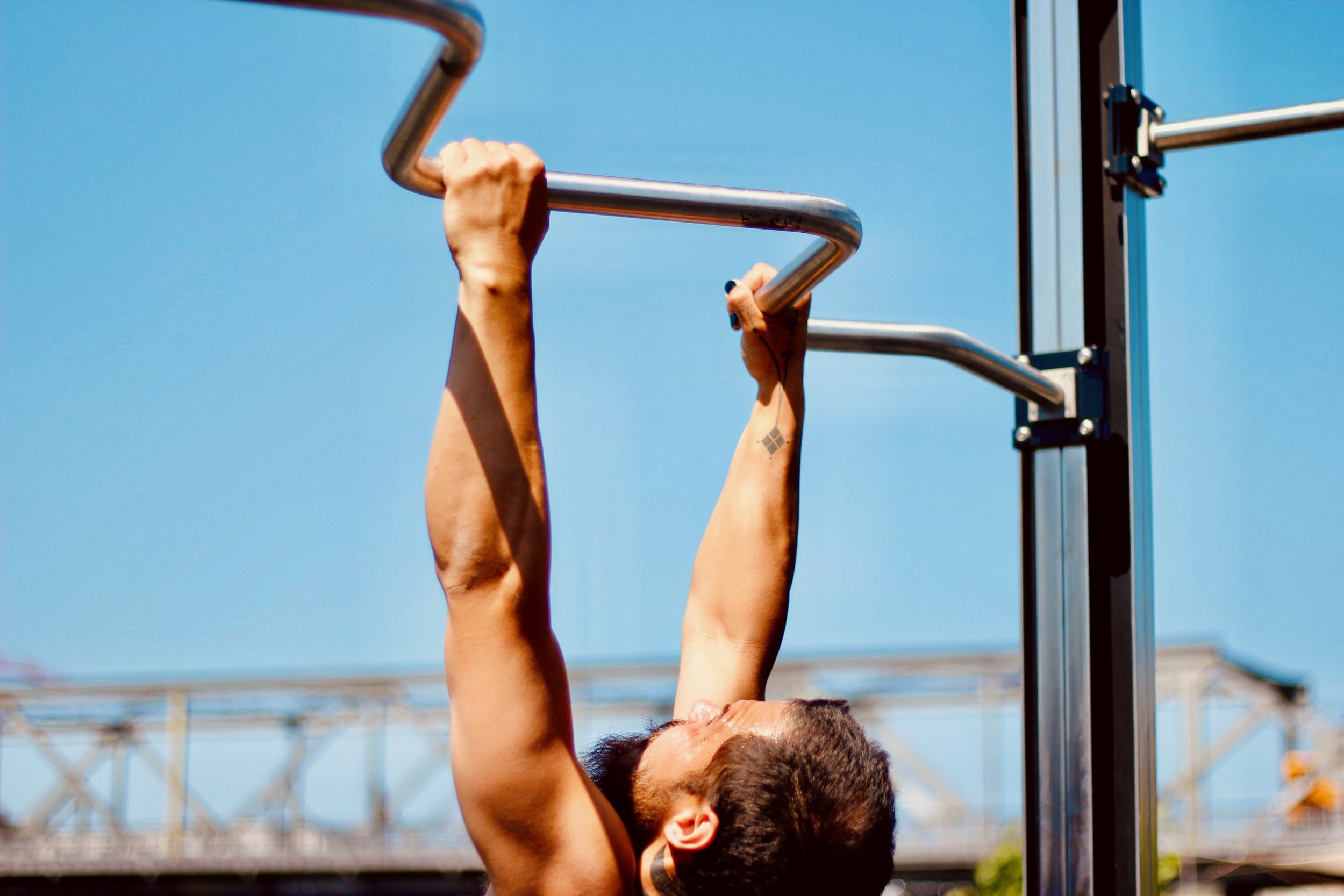
Find a bar, a beam, a door frame — anything you can grip overhead. Hang from it and let your weight drop into your structure.
Not gripping like you're surviving. Not pulling yourself up slightly to stay active and in control. Not bracing against the decompression. Just hanging — weight released, spine long, shoulders allowed to be overhead without a fight.
Most people can't do this. Not because they lack the strength. Because they don't trust what happens when they let go. The body that has spent years bracing, controlling, organising against uncertainty doesn't know how to yield into a position. Even when the position is safe. Even when nothing is actually at risk.
Watch what your shoulders do when you hang. Do they allow the weight, or do they hold it at a slight remove, keeping something in reserve? Do you notice the urge to engage, to grip harder, to manage the sensation rather than receive it? That urge — that inability to simply be in a position without controlling it — is the same pattern that shows up in every other movement you do.
You can be strong and still not feel safe in your own body. Strength and trust are not the same thing.
Can You Carry Yourself?
Only once the first three are available does strength become fully meaningful.
Can you support yourself on one arm — push, pull, hang — with a quality that feels like control rather than survival? Not as a trick or a demonstration. As an expression of a body that knows where it is in space, trusts its own structure, and can direct force without borrowing from somewhere it shouldn't.
Real strength isn't measured by how much you can move. It's measured by how little you need to compensate to move it. A heavy press that requires the spine to extend excessively, the neck to strain forward, the breath to lock — that's not strength organised around a stable centre. That's force borrowed from the body's integrity. And over time, the bill arrives.
Where Most Training Goes Wrong.
The problem isn't usually the programme. It's the layer underneath the programme that nobody addresses.
Most people train on top of their body. They apply effort to it, add load, chase outcomes — but they don't feel what's happening inside it while they do. And this creates a very specific problem that compounds quietly over years: you can build strength inside a pattern that doesn't work. You can stretch without gaining real access. You can become more capable without ever feeling like the capability belongs to you.
That's not a training problem. That's an attention problem. And no programme, however well-designed, solves an attention problem by itself.
The gap that matters
Discipline gets you to the work. Knowledge shapes the work. But attention is what determines whether the work is actually landing — whether the body is learning something new, or just getting better at the same old pattern.
What To Do With This.
If any of the four questions above landed somewhere uncomfortable — if the fold stopped early, if the ground felt foreign, if the hang felt like white-knuckling, if strength feels more like effortful management than honest control — the answer isn't a new programme.
The answer is to start noticing.
Fold forward and feel where it stops. Sit on the ground and feel what resists. Hang and feel what grips. Train strength and feel how you compensate. Don't rush to fix any of it. Just start building a clearer picture of what's actually happening — because you can't change a relationship you haven't honestly looked at.
That shift — from forcing the body to actually listening to it — is the one most people skip entirely. And it's the one that makes everything else start to work.
This is the work underneath the work. If you've been training consistently and something still feels stuck, off, or not quite yours — that's where I start with clients. Not a new system. A more honest relationship with the one you already have.