Your Hips Don't Lie.
But They Might Be Silent.
This piece is about the connection between hip mobility, sexual energy, body image, and what we carry in our backbone. It is direct. It names things that usually go unnamed. And it is written for anyone who has ever felt split — above and below the waist — without quite knowing why.
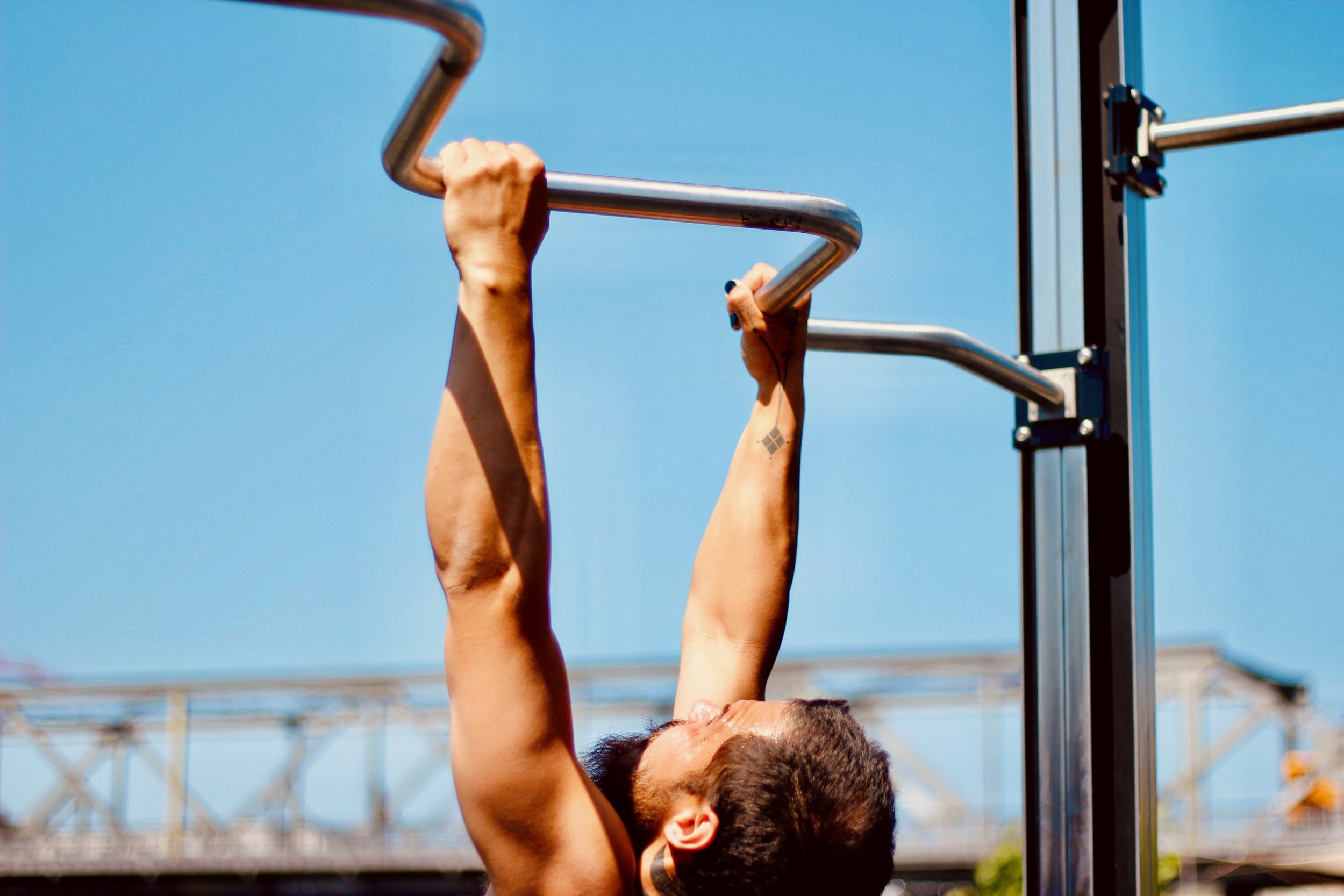
Stand in front of a mirror. Look at yourself from the navel down. Really look — not to assess, not to judge, but to make contact. Notice if you want to look away. That impulse is where this article begins.
Most people live in their upper body. The chest, the shoulders, the arms, the face — these are the parts we present to the world, the parts we train, the parts we recognise in photographs and notice in mirrors. We reach, grip, gesture, and act from here. The upper body is how we manipulate the world.
Below the navel is a different story.
For many people — men and women, regardless of orientation or body shape or level of physical training — the lower half of the body is somewhere between neglected and unknown. Not because it doesn't function. But because it has never been truly looked at, truly felt, truly inhabited. It exists as a base, as a vehicle, as a source of occasional pain or occasional pleasure. Rarely as a home.
This split — at the waist, at the navel, somewhere around the hips — is one of the most consistent things I encounter in the people I work with. And it is almost never talked about honestly.
We learn to live from the chest up. Everything below becomes somewhere we go only when something hurts, or when we're told to.
What You Never Look At.
When did you last stand in front of a mirror and look at yourself below the waist — not to evaluate your legs, not to check your posture, but simply to make contact with that part of you? To look at your hips, your pelvis, your lower belly, with the same quality of attention you might give your face?
For most people, the answer is rarely or never. The mirror relationship, when it exists at all, tends to stop somewhere around the chest. The rest is glimpsed, assessed briefly for acceptability, and moved past. Men often avoid looking at their own lower body entirely — there is something there that feels either irrelevant or too loaded to examine. Women often look but through a layer of evaluation so thick that genuine contact never quite happens.
And then there is sitting. Most people spend the majority of their waking hours with the pelvis tucked under, the hips compressed, the lower back collapsed into a chair — and they never feel it happening. The lower body becomes further and further from awareness because the position that dominates daily life actively closes it off. The hips shorten. The sacrum loads. The breath stops reaching the belly. And because nobody is looking, nobody notices until something starts to hurt.
That avoidance in the mirror and that unconsciousness in the chair are not separate from the tightness you feel in your hips. They are the same relationship, expressed in different postures.
The Hips As Centre.
Across most traditions that understand the body as more than a mechanical structure — yoga, Daoism, somatic practices, the martial arts, many indigenous frameworks — the hips and pelvis are understood as the energetic and sexual centre of the body. Not metaphorically. As a lived reality: this is where vitality originates, where creative and sexual energy is held, where the deepest patterns of holding and release are stored.
You don't need to adopt any particular framework to feel the truth of this. Pay attention the next time your hips are genuinely open and free — after a long walk, after a practice where something released, after sex that felt actually embodied rather than performed. Notice what moves through the body from there. Notice the quality of aliveness that becomes available when that centre is not held against itself.
Now notice what happens when it is. When the hips are chronically tight, compressed, guarded — the energy that should move through doesn't. It sits. It stagnates. The lower back grips to compensate. The breath shortens to stay above the difficulty. And sexual energy — which lives here, which moves through here — has nowhere to go except sideways into tension, or nowhere at all.
Tight hips are not just a mobility problem. They are often a vitality problem. And frequently, underneath that, a sexuality problem — in the sense that the part of the body most intimately connected to sexual experience has been closed, guarded, and cut off from the rest.
What We Carry In The Backbone.
Below the hips, connected through the pelvis and the sacrum, runs the lumbar spine — the lower back. This is where chronic pain lives in more people than almost anywhere else in the body. And it is not coincidental that the place we carry our most persistent pain is also the place most associated with what it means to be strong, upright, and capable.
We talk about backbone as a metaphor for courage. For refusing to bend. For holding firm under pressure. And the body takes that instruction literally.
The lower back that cannot release — that stays braced, that grips even in rest, that cannot yield into a forward fold or soften in a squat — is often carrying something that has nothing to do with muscle tightness. It is the physical expression of not being able to let anything through. Of having learned, somewhere, that yielding is dangerous. That softening means losing. That the moment you release, something will collapse that you cannot afford to have collapse.
That holding is intelligent. It was learned for real reasons. But it is also expensive — paid for in restricted movement, in chronic pain, in a body that cannot rest even when rest is available. And it extends directly into sexual life: a spine that cannot soften cannot receive. A pelvis that cannot release cannot open. The armour that keeps the world at a manageable distance also keeps intimacy at the same distance.
The body that cannot yield in a forward fold is often the same body that cannot yield in intimacy. The holding is not in the muscles. It is in the decision the nervous system made about what is safe.
What Homophobia Does To Movement.
This is worth naming directly, because it operates on almost everyone and almost nobody talks about it in a movement context.
Homophobia is not only an attitude. It is a body organiser. It shapes posture, movement, and the felt sense of what is acceptable to do with a body — in most people, regardless of sexuality, regardless of how open or progressive they consider themselves.
Certain positions are coded. A deep hip opening — hips wide, pelvis dropped, lower back released — can feel uncomfortably exposing for many men, not because it is painful, but because somewhere in the body it registers as soft, as open, as receptive in a way that has been marked as feminine or as gay. The instinct to come out of it, to reassert control, to make the body hard again — that instinct is not about the position. It is about what the position means in a culture that has attached profound anxiety to certain kinds of openness in male bodies.
This is not limited to straight men. Gay men who have organised their sexuality around a top identity — around penetration, around the active rather than receptive role — often carry the same holding in their hips, the same inability to fully open and receive, even in a body and a life that would seem to have made peace with homosexuality. The homophobia is internalised, and it lives in the pelvis as surely as it lives anywhere.
And for women, the coding runs differently but is equally present. The hips that are expected to be open — available, inviting, receptive — can be held closed precisely because of that expectation. When openness is demanded rather than chosen, the body's response is often to guard. The pelvis that appears to move freely may be performing freedom rather than feeling it.
A body organiser, not just an attitude
You don't have to hold homophobic views to carry homophobia in your body. Cultural forces don't require conscious agreement to shape posture, movement, and the felt sense of what positions are acceptable. The holding is often entirely below the level of thought — which is precisely why movement practice, rather than intellectual understanding alone, is what changes it.
The Upper Body Bargain.
For many men, the upper body becomes the site of everything. The chest opens forward — arms wide, hands ready, presence projected outward. The body is shaped to act on the world: to push, to pull, to reach, to grip. This is the body of agency, of doing, of control.
The hips are almost an afterthought. They exist to support the upper body, to generate force for the legs, to carry everything above them. But they are rarely inhabited in themselves. They are rarely felt as a centre of their own — as the seat of something. The investment goes upward. The lower body is serviceable infrastructure.
The woman's version of this is almost perfectly inverted. The upper body often closes — the chest contracted, the shoulders forward, the heart protected behind a rounded posture that has learned to take up less space. While the lower body is culturally expected to be present, available, inviting. The hips as the part of her that belongs to the gaze, to desire, to others' definitions of her femininity.
Both patterns produce the same fundamental split: a body not fully inhabited below the waist, from opposite directions. The man who has never brought his full attention into his pelvis because strength lives elsewhere. The woman who has never fully owned hers because it has always been offered to someone else's story.
What both have in common is that the hips are not truly home. They are managed, performed, avoided, or abandoned — but not lived in.
What Becomes Possible.
When the hips open — not as a stretch to be achieved but as a relationship that slowly becomes possible — something moves that hasn't moved in a long time.
The breath reaches lower. The lower back begins, gradually, to release the grip it has kept for years. The body feels less divided — less like a chest and legs with a problematic middle section, and more like a continuous thing, inhabited from the inside out. Sexual energy, when it has a centre to move through, moves differently. There is more available. More aliveness. More capacity to both give and receive without the constant low-level effort of keeping something held.
This is not a dramatic transformation. It is a slow, earned shift — built through sustained attention to a part of the body that has been avoided, through practices that invite rather than force, through the willingness to feel what is actually there rather than what the performance requires.
It requires looking in the mirror below the navel. Not to assess. To make contact. To begin treating that part of you as somewhere that belongs to you — not as infrastructure, not as performance, not as something to manage or hide or offer up, but as the actual centre of a living body that has been waiting for your attention.
A starting point
Stand in front of a mirror, or simply stand and close your eyes. Place both hands on your hips — the bones, the sides of the pelvis. Feel the weight of them. Feel how they sit in relation to the floor, in relation to your spine above them.
Begin to move them slowly. A small circle. Not an exercise — just motion. Notice immediately where the movement stops being fluid. Notice if there is a direction that feels acceptable and a direction that feels wrong somehow. Notice if the movement feels like yours, or like something you are performing.
Stay with that noticing for two minutes. Don't try to fix anything. The point is only to make contact — to bring attention to a part of the body that has likely been outside your awareness for a long time. Everything else begins from there.
This territory — the body below the waist, the hips as centre, sexuality as something that lives in physical experience rather than only in the mind — is part of the work I do with clients. Not as a side topic. As a central one. Because the body that is split at the waist is not a fully inhabited body. And the work of becoming more fully yourself always, at some point, comes back here.