I Built The Body.
It Wasn't Enough.
This is the story behind MB Coaching — not as a brand origin, but as an honest account of what it took to stop performing strength and start actually living inside it.
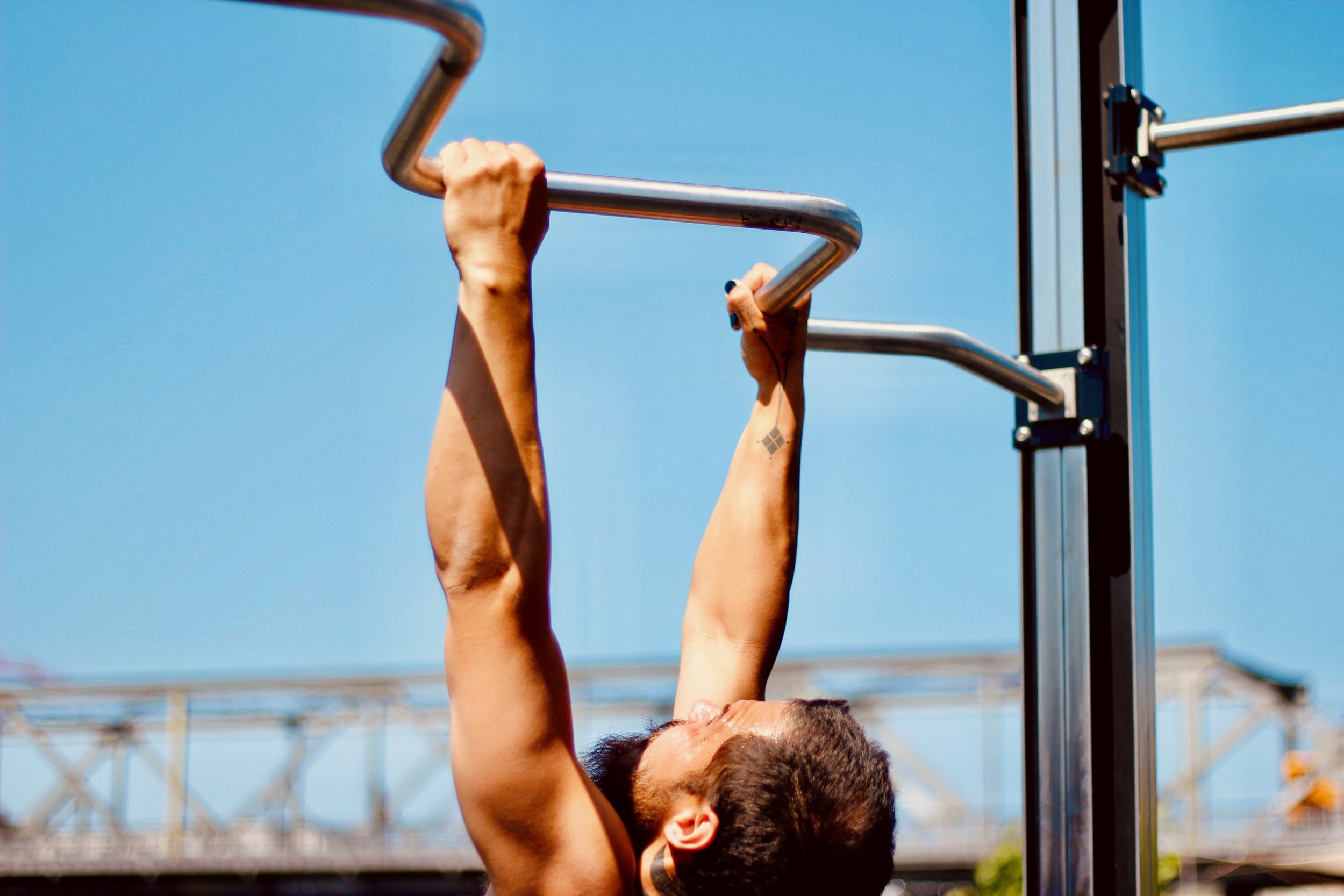
At some point I had to stop asking what the body could do, and start asking what it was carrying. The answer changed everything.
I was seventeen when I understood, clearly and for the first time, the difference between looking strong and being strong.
I grew up inside a culture that put physical strength above almost everything else. Boys becoming men, or trying to. Competition. The pressure to belong, and simultaneously to be superior. The body was currency — and the body was a performance. You built it for others to see, even if you told yourself you were building it for yourself.
Underneath all of that, privately, I was searching for something else entirely. I wanted safety. I wanted control. I wanted the kind of self-mastery that would make everything else — the fear, the insecurity, the not-quite-belonging — finally fall into place. The logic felt sound: if I could build my body exactly as I wanted it, the inside would follow.
So I built it.
The compliments arrived. The acknowledgements arrived. The fear and shame did not leave. They had simply learned to wait beneath a more impressive surface.
What Succeeding Didn't Fix.
By external measures, I was succeeding. Aesthetically, physically, in terms of what the body could do. I had walked considerable distance down that path — further than most people around me were interested in going.
But the internal experience didn't match the external achievement. The compliments didn't land. The acknowledgements didn't touch anything real. I had a high-held philosophy about skill and depth and genuine capacity over surface aesthetics — and almost nobody around me was interested in or equipped to grasp it. They saw what it looked like. That was enough for them. It wasn't close to enough for me.
I still could not fully be who I wanted to be, or how. The physical path was clear and I was walking it. But the thing I was actually looking for wasn't at the end of it.
The Thread That Was Always There.
Philosophy was never separate from any of this. It ran alongside everything, sometimes underneath it.
I went to church with my mother as a child — freely, not reluctantly. I chose philosophy as a subject in school when I could have chosen something easier. I was drawn early to East Asian thought: Daoism, Buddhism, the martial traditions that understood the body as a site of practice rather than performance. And alongside that, a fascination with the esoteric, the mystical, the animistic — my own indigenous heritage included. A holistic, undogmatic view of the world that refused to separate the physical from the philosophical, the body from the spirit.
What I was looking for, I think, was a way of being in the body that the fitness world couldn't offer. Not a better programme. A different relationship with existence entirely.
The traditions that moved me most shared one thing: they understood the body not as something to be conquered, but as something to be inhabited.
Meeting People Who Could Walk It.
The turning points in my development were almost always people. Not systems or methods — people who embodied what they talked about. Thinkers who were also practitioners. Teachers whose bodies told the same story as their words.
Meeting Ido Portal was one of those moments. Here was someone operating at the intersection I had been searching for — movement as philosophy, physicality as inquiry, the body as a lifelong practice rather than a destination. It was a kind of permission. Proof that the synthesis I had been reaching toward was real and liveable.
There were others. Some named, some not. What they shared was the ability to close the gap — between knowing and doing, between theory and sensation, between the intellectual understanding of embodiment and the actual, daily, unglamorous practice of it.
Eight Years of Ritual.
For eight years I worked at Vabali Spa in Berlin — leading sauna infusions, meditations, ceremonies, and rituals for the people who came through. It was, in hindsight, as formative as anything I had done in training. Perhaps more.
Vabali is a nude spa. On a typical day I was in the presence of several hundred naked bodies. Thousands per month. That kind of sustained, unavoidable exposure does something that no amount of intellectual work around body image can replicate. It confronts you, repeatedly and without negotiation, with the reality of bodies as they actually are — not performed, not curated, not dressed for the occasion.
I came in confident and physically capable. I had built that. But confidence on top of self-consciousness is not the same as being free of it. The exposure worked on me too. Slowly, through sheer accumulation, the layers of residual self-consciousness I hadn't even known were still there began to dissolve. Not through effort or intention — through presence. Through being in that environment every day until it stopped being something to manage and started being something to inhabit.
What I witnessed in others was equally formative. Something happens to people in spaces like that. When the performance layer is removed — literally, physically — something underneath it becomes available. People come together differently. They soften. They become more genuinely themselves. The usual social armour is in the locker. What remains is more honest, more human, and often more tender than anything that happens when everyone is dressed.
That was a living laboratory for everything I now understand about embodiment. Not as a concept — as a daily, witnessed reality.
During those years I was also using the sauna and ice bath as training tools — daily, systematically, long before heat and cold exposure became a wellness trend. I was pushing the edges of what I could do and recover from in training, and the thermal practice was central to that. It wasn't a protocol. It was just part of how I moved through the world and took care of the body I was asking a great deal of.
Leaving Vabali was one of the stepping stones toward MB Coaching. Not a departure from that work — a focusing of it.
When The Body Stopped Me.
At the end of a year of heavy, progressive lifting — the most physically demanding training I had ever done — I suffered two herniated discs.
It should have been devastating. For someone whose identity was so bound up in physical capacity, a spinal injury at the height of that capacity had every reason to be a breaking point. It wasn't.
The practice held. Not the training programme — the practice. The internal orientation I had spent years developing. The ability to feel what was happening rather than push through it. The philosophical foundations that understood difficulty as information rather than obstacle. I met the injury from inside a relationship with my body that was already built on something other than performance.
That was the proof of concept I hadn't known I was working toward. The somatic foundation carried me through what the physical development alone never could have.
The Life That Holds All Of This.
I have been with my partner for eighteen years. We have an eight-year-old daughter. The relationship has evolved — not despite the work I've done on myself, but alongside it and sometimes because of it. There have been periods of deep personal investigation: territories of the self I hadn't had the courage or the clarity to explore before. The kind of inner work that is inseparable from embodiment, from philosophy, from the ongoing project of becoming more fully and honestly oneself.
I don't separate these threads. The personal and the professional, the physical and the philosophical, the private and the practitioner — they are all part of the same inquiry. MB Coaching exists because of all of it, not just the parts that look like credentials.
Why Any Of This Matters For You.
I am not telling this story to establish authority. I'm telling it because the work I do with clients comes directly from it.
The seventeen-year-old who built the body and still felt the fear — I know that person from the inside. The one who trained consistently and couldn't understand why it wasn't fixing the right things. The one who found more meaning in a Daoist text or a moment of genuine stillness than in any personal record. The one whose body stopped them completely and had to find out what the practice was actually made of.
That's the lineage of this coaching. Not a methodology adopted from somewhere else. A practice grown from the particular shape of one life — and offered, now, to people who recognise something of their own situation in it.
If the body has been a project you've pushed rather than a home you've inhabited — that's where we start.